トップページ > 区政情報 > 広報・報道 > 広報紙 > Minato Monthly > Minato Monthly, 1 2026 > Know the slopes, see the history. The Story of Minato City’s Slopes | Minato Monthly, 1 2026
更新日:2026年1月1日
ページID:175260
ここから本文です。
目次
Know the slopes, see the history. The Story of Minato City’s Slopes
Minato City consists of elevated land in the northwest, lowlands facing Tokyo Bay in the southeast, and reclaimed land along the Shibaura waterfront, which makes the city the most topographically varied of Tokyo’s 23 cities.
For this reason, the city contains many slopes—more than 80 in total.
The area now known as Minato City has been populated since the Edo period. Areas with samurai residences, temples, and shrines often had no town names, so slopes were named to serve as landmarks.
Slope names originate from many sources: the slope’s appearance, personal names, feudal lords’ residences, legends, and even local rumors.
Each slope marker displays the origin of its name. If you find one in town, please take a moment to read it. Some of the slopes are introduced in this article.
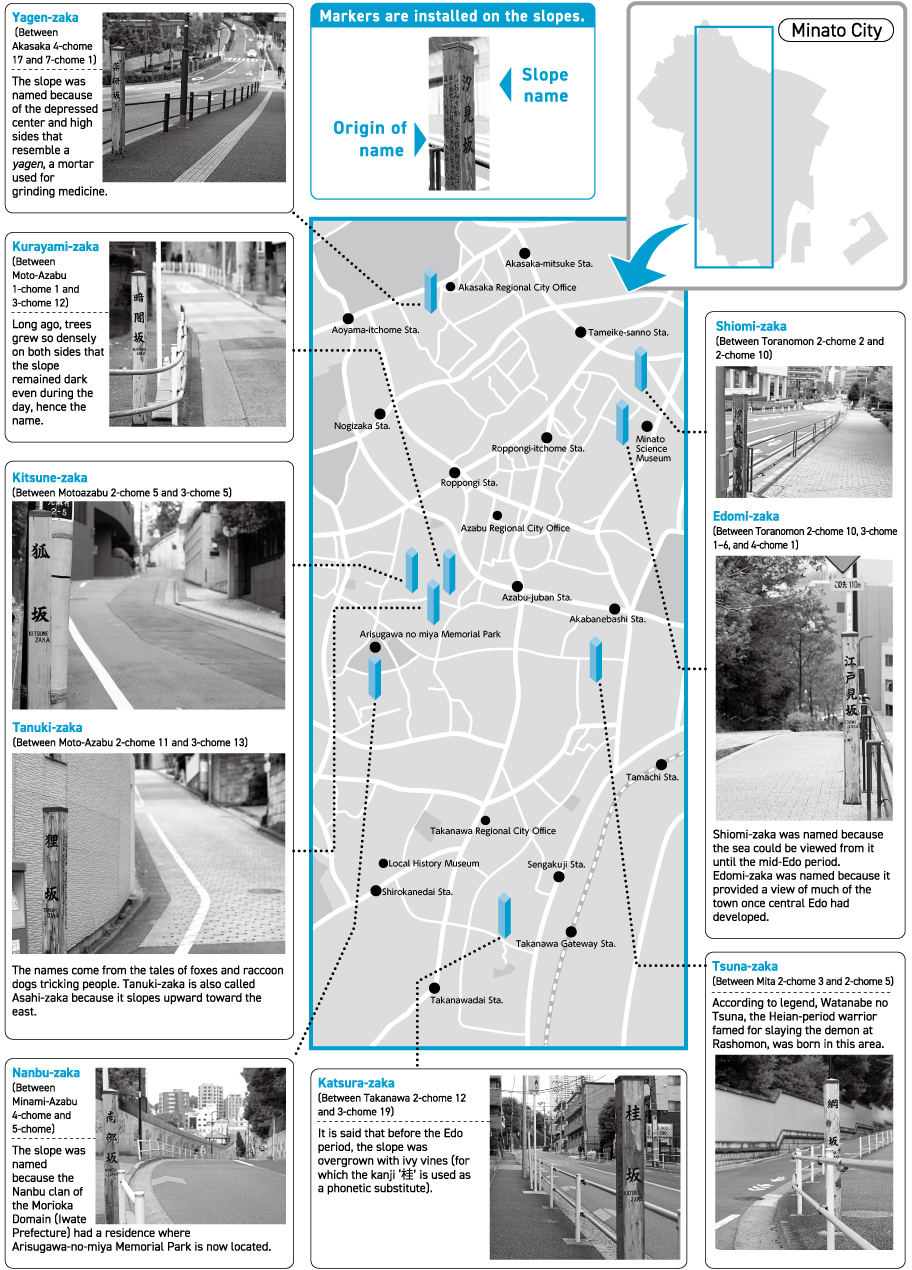
Yagen-zaka
(Between Akasaka 4-chome 17 and 7-chome 1)
The slope was named because of the depressed center and high sides that resemble a yagen, a mortar used for grinding medicine.
Kurayami-zaka
(Between Moto-Azabu 1-chome 1 and 3-chome 12)
Long ago, trees grew so densely on both sides that the slope remained dark even during the day, hence the name.
Kitsune-zaka
(Between Motoazabu 2-chome 5 and 3-chome 5)
Tanuki-zaka
(Between Moto-Azabu 2-chome 11 and 3-chome 13)
The names come from the tales of foxes and raccoon dogs tricking people. Tanuki-zaka is also called Asahi-zaka because it slopes upward toward the east.
Nanbu-zaka
(Between Minami-Azabu 4-chome and 5-chome)
The slope was named because the Nanbu clan of the Morioka Domain (Iwate Prefecture) had a residence where Arisugawa-no-miya Memorial Park is now located.
Katsura-zaka
(Between Takanawa 2-chome 12 and 3-chome 19)
It is said that before the Edo period, the slope was overgrown with ivy vines (for which the kanji ‘桂’ is used as a phonetic substitute).
Shiomi-zaka
(Between Toranomon 2-chome 2 and 2-chome 10)
Edomi-zaka
(Between Toranomon 2-chome 10, 3-chome 1–6, and 4-chome 1)
Shiomi-zaka was named because the sea could be viewed from it until the mid-Edo period.
Edomi-zaka was named because it provided a view of much of the town once central Edo had developed.
Tsuna-zaka
(Between Mita 2-chome 3 and 2-chome 5)
According to legend, Watanabe no Tsuna, the Heian-period warrior famed for slaying the demon at Rashomon, was born in this area.